

Elector Karl Ludwig of the Palatinate
Early concept of tolerance City privileges 1652
When Karl Ludwig (1) was born in Heidelberg on December 22, 1617, his future seemed bright. He was the second-born son of the Palatine Elector Frederick V (2) and his wife, the English Princess Elizabeth Stuart (3). At that time, marriages of noblemen were not a private matter, but rather had great political significance. The marriage between the 16-year-old Frederick and the daughter of the English King James I, who was the same age, was arranged in London in February 1613 in order to counterbalance the supremacy of the Catholic Habsburgs by uniting the two important Protestant families. But it was also a marriage of love. The English building of Heidelberg Palace with its magnificent banqueting hall high above the city, the Elisabeth Gate, the famous palace garden "Hortus Palatinus" (4), which Frederick had laid out for his wife, and not least the couple's thirteen children bear witness to this. Their first child, Frederick Henry, was born on New Year's Day 1614. (5)


At this time, the predominantly Protestant nobility in Bohemia began to rebel against the Catholic King Ferdinand of the House of Habsburg, as he disregarded the religious freedom granted to them and was tyrannical. In May 1618, the conflict led to the "Defenestration of Prague" (6), during which the rebels threw three Catholic governors into the castle moat. Finally, in August 1619, the Bohemian estates declared King Ferdinand deposed and elected the 23-year-old Elector Frederick V as their new king.
At first, Frederick hesitated. His advisors and also his father-in-law James I of England had reservations. However, his ambitious chancellor Christian von Anhalt, the missionary zeal of the Archbishop of Canterbury and his wife Elisabeth encourage Frederick to accept the Bohemian royal crown offered to him. In the end, Frederick decided "not to resist the will of the Almighty" and to accept the election. Educated as a Calvinist in the spirit of the Heidelberg Catechism, he felt obliged to do so.


On October 31, 1619, Frederick arrived in Prague with his family, court and almost 100 carriages, where he was enthusiastically welcomed and crowned four days later in St. Vitus Cathedral (7). However, Frederick, who did not speak a word of Czech and was unfamiliar with the culture, quickly made himself unpopular when he raised taxes, introduced universal conscription, removed religious art treasures from St. Vitus Cathedral and even had Lucas Cranach's famous altar of the Virgin Mary destroyed.
Meanwhile, Ferdinand (8) seeks support and allies himself with the Spanish and the Bavarian Duke Maximilian I, the leader of the Catholic League. The aim was not only to regain the Bohemian crown, but above all to defend the supremacy of the Catholics. As Elector and King of Bohemia, Frederick had two votes in the election of the Emperor, giving the Protestants a majority.

In the Battle of White Mountain (9) near Prague on November 8, 1620, the Bohemian army is crushed by the imperial superiority. The next morning, Frederick, who was later put under the imperial ban, fled with his family to the Netherlands and went down in history as the "Winter King".
The aristocratic leaders of the uprising are executed, the right of the estates to elect the king is abolished and Catholicism is restored. As their faith is now forbidden, 30,000 Protestant families are forced to leave Bohemia. During the ensuing 30 Years' War, more than half a million people in Europe lose their homes.
In 1622, the Palatinate is conquered and plundered by troops of the Catholic League under the leadership of the notorious General Tilly. The precious Bibliotheca Palatina (10), one of the most important libraries of the Renaissance, was stolen from the Heiliggeistkirche and given to the Pope. Duke Maximilian of Bavaria, who belonged to the Catholic Palatinate-Neuburg line, received the title of Elector Palatine in gratitude for his help.

Karl Ludwig spends his childhood together with his older brother Heinrich, his two younger brothers Ruprecht and Moritz and his sister Elisabeth in exile in Holland, where a further eight siblings are born. They all received an excellent education and were brought up to become the most educated princes of their time.
Elisabeth (11) becomes abbess of a Protestant convent and corresponds with René Descartes, who even dedicates his main work of natural philosophy to her.
Ruprecht (12), the future Duke of Cumberland, lays the foundation for the later English naval power as an admiral and becomes governor of "Ruprecht's Land" in Canada, named after him.
Louise Hollandine (13), born in Holland and an outstanding painter, converts to the Catholic faith and becomes abbess of a Cistercian monastery.
Sophie (14), the youngest daughter, marries the Elector of Hanover. Their son, George I, becomes the first English king from the House of Hanover, which still reigns today, but later takes the name Windsor.


Karl Ludwig was brought up multilingual. In addition to English, French and Dutch, he also spoke Italian and studied Latin and Greek in Leiden. He is also taught history, philosophy, law and political theory. He received military training under Frederick Henry of Orange. After his older brother Frederick Henry drowned in a shipwreck in January 1629 at the age of just 15, Charles Louis (15) became crown prince and elector.
Frederick leaves no stone unturned in his efforts to obtain the return of the Palatinate and reinstatement as Elector, but Emperor Ferdinand remains implacable and a military reconquest has no prospect of success. Even his friend, the Swedish King Gustav Adolf, was unable to help him. In November 1632, Frederick (16) dies of the plague at the age of just 36. His widow Elisabeth (16) takes over the task of winning back the Electoral Palatinate for her son Charles Louis with the help of her brother, the English King Charles I.
However, when the Peace of Prague in 1635 ignored Charles Louis' claim to the Electoral Palatinate, he and his brother Ruprecht went to the court of their uncle Charles I in England. (17)


With English money, Charles Louis was able to buy the Meppen estate in Emsland as a military base in 1638, but soon lost it to the Imperial forces. The following year, his attempt to take over the army of the late Bernhard of Saxe-Weimar in Alsace was also doomed to failure. On his journey there, Charles Louis was interned on the orders of Cardinal Richelieu until he had secured the Weimar troops for the French king. Karl Ludwig returns to England, where he witnesses the revolution and civil war. His brothers Ruprecht and Moritz fight alongside their uncle Charles I.
It was not until the Peace of Westphalia in 1648 that Charles Ludwig regained part of the Electoral Palatinate. The Upper Palatinate and the County of Cham remain with the Bavarians. These territories only revert to the Palatinate in 1777 after the extinction of the Bavarian line.
After the execution of Charles I, Karl Ludwig left England and returned to Heidelberg in October 1649, exactly 30 years after his parents had left for Prague. (18) He is confronted with a picture of complete devastation. The castle was destroyed, towns and villages burnt down and deserted, most of the once cultivated fields lay fallow. There are only a few farmers left to cultivate the fields and vineyards. During the Thirty Years' War, the Electoral Palatinate lost almost three quarters of its population. As a result, the Elector can hardly generate any income. The Rhine customs duties also largely ceased to be a source of income, as there was hardly any transportation of goods. The Palatinate is in ruins and has become politically and militarily insignificant, as well as being heavily in debt.

But Karl Ludwig is determined to quickly rebuild the destroyed and depopulated Palatinate. First, he obtains a loan from Protestant towns in Switzerland at usurious interest rates, for which he pledges the electoral jewels. At the same time, he ensured that public funds were used sparingly. His court, too, is a place of ironclad austerity. Above all, it was important to him to bring people back into the country. After all, the level of taxability and thus the revenue depends above all on the number and prosperity of the subjects. And the amount of revenue determines whether a prince can afford a powerful army to secure his political power. For political power in the 17th century depended on military power even more than it does today.
In the Netherlands, Charles Louis had experienced how tolerance and freedom, indirect taxation, the restriction of official regulation of trade and commerce and, not least, the peaceful coexistence of different faiths contributed to the economic prosperity and wealth of the citizens.
In order to attract "...honest people from all nations", Karl Ludwig therefore issued the "Privileges of the City of Mannheim in the Churpfaltz" in 1652.

Its nineteen articles, written in German, Dutch and French, guarantee all citizens extensive rights, freedoms and even tax relief and subsidies.
New citizens of any nationality as well as returning residents are exempt from paying taxes for a period of twenty years. On request, they were given a free building plot for which only an annual ground rent was due, a kind of hereditary leasehold. There is no serfdom in Mannheim. But freedom of religion. Even though the Reformed denomination remained privileged, anyone was allowed to settle in Mannheim, regardless of religion or denomination. Mennonites and Jews, who were not mentioned in the city privileges, were also welcome. The Jewish community was founded in 1661.
There were no quarters in which people of a particular religion or descent had to live, nor were there any occupation-related quarters. The privileges granted freedom of trade and commerce. The 11th article states that the cloth trade is to be handled freely and the 12th article stipulates that "no trade or craftsmen shall be subject to guilds in Mannheim." Article 13 stipulates that the "moats and ramparts in the city of Mannheim shall be cleaned up by Your Electoral Serene Highness and repaired and maintained at your own expense, including all bridges and gates."
Before a new measure is ordered, it must be examined to see whether it is conducive to immigration or could lead to emigration. Tax increases or the introduction of new taxes must also be publicly justified.
In order to achieve even greater tax justice and more tax relief, the privileges were supplemented in 1661 by the introduction of independent committees. Elected deputies examine the tax returns, known at the time as "food slips", and carry out the "Schatzung", i.e. the tax assessment. Every taxpayer had the right to be heard before being assessed.
Convinced of the importance of education, Karl Ludwig also promoted science and ordered Heidelberg University to resume its teaching activities, which had been discontinued during the Thirty Years' War, and appointed the best teachers. Heidelberg develops into an important place of learning, especially for civil servants and clergy. Christian Mayer and Johann Jakob Hemmer later benefit from this. Karl Ludwig also endowed scholarships for two or three sons of the townspeople so that they could devote themselves to higher studies.


The immigrants, mainly from France, but also from England, Flanders, Switzerland, Holland as well as Mennonites and numerous Jews, together with the returning Palatines, rebuild Mannheim from rubble and ashes, which had been destroyed in 1622, barely 15 years after it was founded. Within a decade, the population, consisting of different nationalities and religions yet living together peacefully, grows to over 3,000 inhabitants.
Fallow fields and vineyards are replanted, tobacco and potato cultivation are introduced and agriculture is revived.
Last but not least, the upswing in trade is also important to Karl Ludwig, as he sees it as the driving force behind the prosperity of his country. In order to facilitate the sale of Palatine products, Karl Ludwig attempts to reduce customs duties. At that time, ships on the Rhine between the mouths of the Neckar and Ruhr rivers had to pass through the customs and toll stations of more than 28 small states. However, the many customs duties made ship transportation unprofitable. Karl Ludwig tried in vain to convince the princes that lower customs revenues would be more than offset by the expected increase in transportation. It was not until 200 years later that the far-sighted Karl Ludwig achieved his goal with the Rhine Navigation Act of 1868.
The Elector had Friedrichsburg Castle rebuilt, as well as Schwetzingen Palace, which had also been destroyed in the Thirty Years' War. The inhabitants cleared away the rubble and were allowed to use it for themselves.
In 1650, at the age of 33, Karl Ludwig marries Charlotte, (21) the daughter of Landgrave Wilhelm V of Hesse-Kassel. This marriage produced the children Karl and Elisabeth Charlotte, known as Liselotte. Frederick, born in 1653, dies soon after birth. Thereafter, the electoral couple's marital relationship increasingly deteriorated and their differing views and characters clashed more and more. Charlotte, for whom representation befitting her rank was important, was unable to understand the frugal Karl Ludwig and his renunciation of courtly luxury and glamorous appearances. The fact that the Elector turned to Marie Louise von Degenfeld (22), the lovely lady-in-waiting of his often moody wife, probably played a not insignificant role in the disputes, which even took place in front of guests.

The electoral couple's marriage then broke down so badly that Karl Ludwig wanted a divorce, but Charlotte did not agree to it. In 1657, Karl Ludwig, who as Elector had jurisdiction, finally declared the marriage dissolved and married his Louise a few months later in the Frankenthal garrison church. However, because she was not in keeping with her station and, above all, because the electress did not consent to the divorce, the marriage was only concluded morganatically as a second marriage to the left hand.
Louise therefore did not become electress and the 13 children of this happy marriage also remained illegitimate. However, Karl Ludwig elevated Louise and the eight children who reached adulthood to the rank of Raugrafen.
The early death of five of his children shook Karl Ludwig to the core. At the funeral of his nine-year-old daughter Frederike, he writes:
"Why then must my dearest, innocent children die not only so early, but also with such pain, now for the second time? Have I not been punished enough in so many other matters, do I overreach myself so much with pleasure and fail in my duties?"
On March 18, 1677, Louise died giving birth to her 14th child. The deeply saddened Karl Ludwig dedicates a commemorative coin to her, which reads "Dedicated to eternity". Eleven days later, the foundation stone for the Concordia Church, named after the Latin word concordia = unity, is laid in the Friedrichsburg fortress, where Louise is buried in a crypt. Karl Ludwig himself designed the inscription for her tomb monument.
After the marriage of his only legitimate son, Elector Prince Karl, who was married to Princess Wilhelmine Ernestine of Denmark, had been without offspring for seven years, Karl Ludwig wanted to remarry after Louise's death in order to secure the succession of the Palatinate-Simmern line. But Electress Charlotte still refuses a divorce. And his only surviving brother Ruprecht does not want to marry.

Consecrated in 1680 as a sign of religious tolerance, the Concordia Church is open to all Christian denominations for services. A German Reformed, a Lutheran and a Catholic pastor preach at its inauguration. Karl Ludwig's aim was for these Christian denominations to agree on the common foundation of the Christian faith without abandoning their fundamental beliefs (Irenics).
Karl Ludwig was no longer able to realize his goal of confessional union between the Reformed and Lutherans. He died under a tree on August 28, 1680 on his way from Mannheim to Heidelberg near the village of Edingen.
Karl Ludwig's eldest son becomes Charles II, Elector Palatine, and within a short time squanders the fortune his thrifty father had saved over many years. When Charles II dies childless five years later, the Protestant House of Palatinate-Simmern ceases to exist and the Palatinate falls to the Catholic Palatinate-Neuburg line. A short time later, the War of the Palatinate Succession begins.
Charles Louis had always followed the expansive foreign policy of Louis XIV with concern and considered it threatening. He was aware that he would not be able to afford the costs necessary to defend his country against his powerful neighbor in the long term. However, he hoped that the marriage of his daughter Elisabeth Charlotte to the Duke of Orleans, the only brother of the French king, could keep the peace and protect his palatinate. He even complied with the demand that the young Countess Palatine convert to Catholicism. After her marriage on a cold November day in 1671, Liselotte lives a homesick life as Duchess of Orléans at the court of Louis XIV in Versailles. She would never see her beloved Palatinate again.
Nevertheless, the Palatinate is not spared new misery. After the death of her brother Charles
Louis XIV, against her will and yet in her name, claims to inherit Charles II's property and in particular large parts of the Electoral Palatinate, which Emperor Leopold I and the Imperial Diet reject. As a result, French troops marched in late 1688 to enforce the claims by force. This is the beginning of the "Palatinate War of Succession", which lasts until 1697.

As early as March 1689, Mannheim's inhabitants were expelled, the fortress blown up, the fountains filled in, the city plundered and razed to the ground. Speyer and Worms suffer the same fate. General de Mélac also had Heidelberg and its castle burned to the ground. The ruins of Heidelberg Castle are still a reminder of this today.
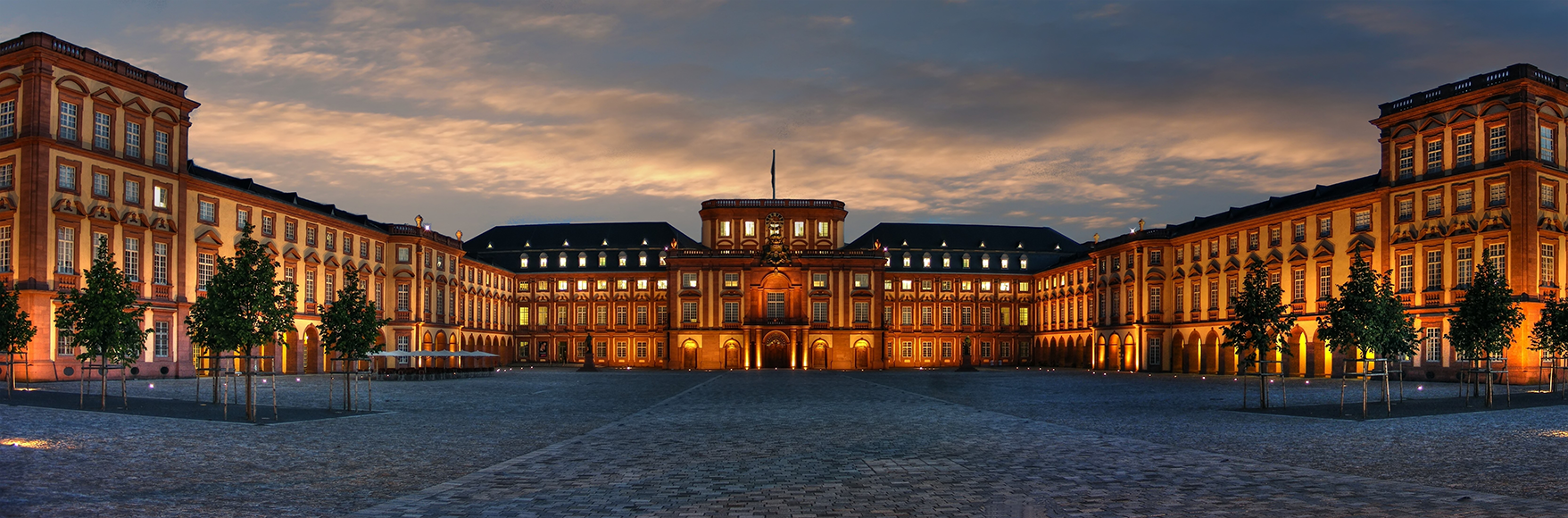
Along with the fortress, the Konkordienkirche was also blown up just nine years after its inauguration. Mannheim Castle now stands on this site. It was not until 1706 that the reconstruction of the reformed Konkordienkirche began in square R 2, where it can still be found today.
Elector Karl Ludwig von der Pfalz was an enlightened ruler. At a time when absolutism, autocratic authoritarianism and religious fanaticism prevailed in Europe, he advocated religious tolerance. The city privileges he granted to the city of Mannheim established the first modern city constitution. It granted the subjects municipal self-government and, with its liberal and business-friendly provisions, enabled a progressive administrative and economic policy. Karl Ludwig thus demonstrates a remarkable understanding of the needs of his country.
A monument in the courtyard of honor at Mannheim Palace commemorates this great elector.